
Short answer: Firewise landscaping is designing your yard so it slows a wildfire instead of feeding it. In Southern Oregon that means a noncombustible zone in the first 5 feet around your home, well-spaced and well-watered plants beyond it, fewer ladder fuels under trees, and hardscape that breaks up fuel. Done well, it still looks like a garden, not a gravel lot.
For homeowners in Grants Pass, Medford and the rest of the Rogue Valley, wildfire planning is now part of every good landscape design. This guide explains the defensible space zones, which plants and materials work, and how to keep a firewise yard beautiful.
Key takeaways
- Start at the house: the first 5 feet should be free of anything that burns, including bark mulch.
- Space plants and trees so fire can’t climb or jump from one to the next.
- “Fire-resistant” plants still burn if they are dry or neglected; maintenance matters.
- Patios, walkways, gravel and stone walls double as fuel breaks.
- Water-wise and firewise design work together when they are planned together.
What Is Firewise Landscaping?
Firewise landscaping uses plant choice, spacing, materials and layout to reduce how easily fire and embers can reach and ignite your home. It is closely tied to defensible space: the area around a house where vegetation and other fuels are managed so a fire loses energy as it approaches.
It matters here because Grants Pass, Medford and the surrounding hills combine hot, dry summers, long fire seasons, slopes and a lot of wildland edge. In 2026 the Oregon State Fire Marshal finalized a defensible space model code that cities, counties and fire agencies can choose to adopt. It is a baseline standard, not a statewide mandate, so check whether your city or fire district has adopted it.
What Are the Defensible Space Zones?
The Oregon State Fire Marshal organizes defensible space by distance from the house. Here is how those zones typically translate into landscape design.
| Zone | Distance from home | What firewise design typically looks like there |
|---|---|---|
| The home | Roof, gutters, vents, siding | Roofs and gutters kept clear; vents covered with 1/8-inch metal mesh |
| Immediate | 0–5 feet | River rock, gravel or pavers instead of bark mulch; no flammable plants such as junipers; nothing stored under decks |
| Intermediate | 5–30 feet | Grass kept under 4 inches; tree crowns spaced about 10 feet apart; lower branches pruned up about 6 feet; ladder fuels removed |
| Extended | 30–100+ feet | Dense brush thinned; dead wood and heavy litter removed |
Other practical details from the same guidance: keep 10 feet clear around propane tanks, use metal gates where fences come within 5 feet of the house, and keep driveways open enough for a fire engine.
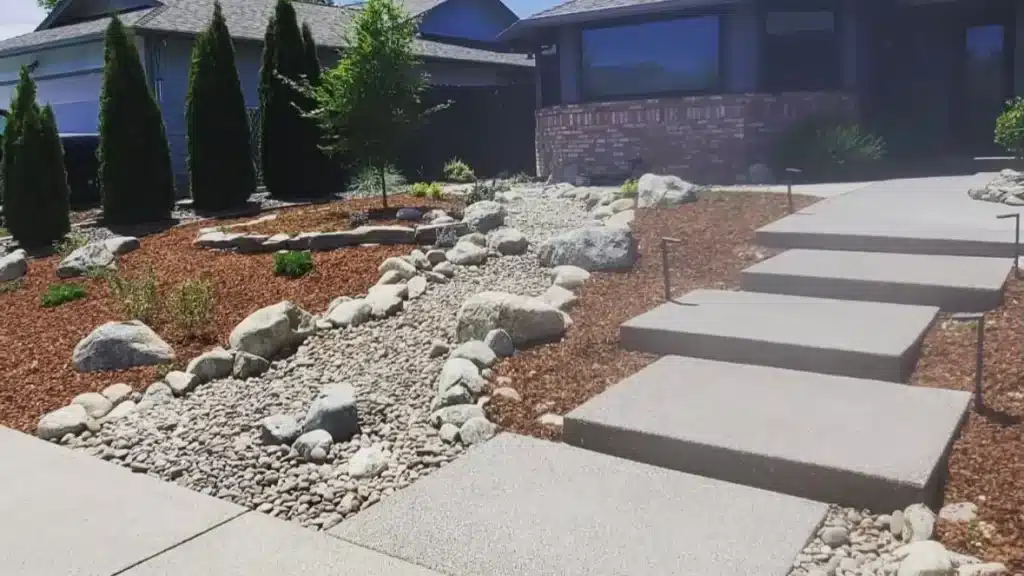
How Do You Design the First 5 Feet Around Your Home?
This is the zone that matters most, because embers landing against the house are how many homes ignite. The goal is a band of noncombustible material that still looks intentional.
- Gravel or river rock beds in place of bark mulch, edged cleanly so they read as a design choice.
- Paver or concrete walkways wrapping the house, which also make maintenance easier.
- Stone or concrete planters and boulders for texture without fuel.
- Containers you can move, kept watered and set away from siding.
- Clear space under decks and stairs, finished with gravel rather than used for storage.
Our hardscaping team builds these walkways, patios and gravel bands as one connected system, so the noncombustible zone looks like part of the design.
Which Plants Are Best for a Firewise Yard in Southern Oregon?
No plant is fireproof. According to Oregon State University Extension’s fire-resistant plants guide, lower-risk plants tend to have moist, supple leaves, open and loose branching, little dead wood or dry buildup, and watery sap with little resin or strong scent.
Higher-risk plants tend to have fine, dry or dead material, aromatic or oily leaves, resinous sap or papery bark. OSU names spreading and upright junipers and Leyland cypress as examples of highly flammable plants, and advises keeping most conifers away from the house.
Placement matters as much as species. Avoid continuous rows or hedges that carry fire toward the house, group plants in islands separated by gravel, paths or lawn, and keep them healthy. Many fire-resistant plants still need some summer water, which is where smart xeriscaping and efficient drip irrigation come in. For water-wise natives that suit the region, see our 5 native Southern Oregon plants for xeriscaping, then choose and place them with fire in mind.
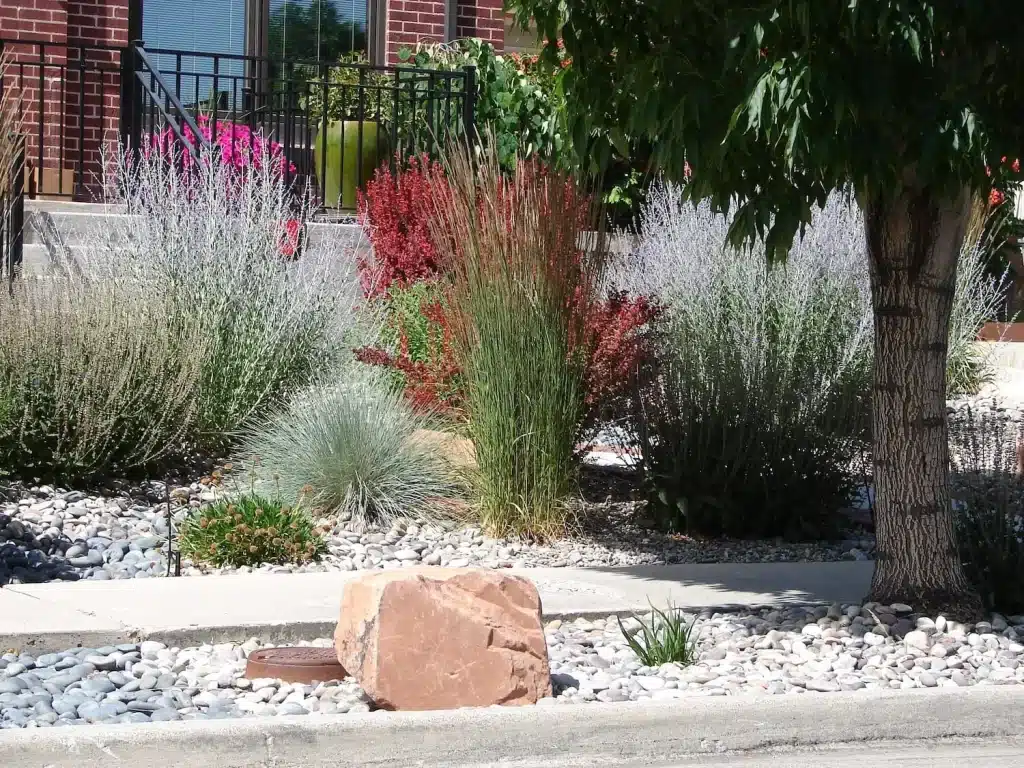
Can a Firewise Landscape Still Look Beautiful?
Yes. The best firewise yards look designed, not stripped. A few principles keep them attractive:
- Use hardscape as structure. Patios, paths, seat walls and dry creek beds create the bones of the garden and break up fuel at the same time.
- Plant in islands. Clusters of low, well-watered perennials and shrubs separated by stone or paths look intentional and slow fire spread.
- Layer by distance. Keep the lowest, greenest plantings closest to the house and larger shrubs and trees farther out.
- Light the paths. Low-voltage outdoor lighting highlights stone and plant textures at night.
- Plan any fire feature carefully. If you want a fire pit, place it on a noncombustible patio well away from the house and trees. Our guide to fire pits vs. outdoor fireplaces covers placement and clearance.
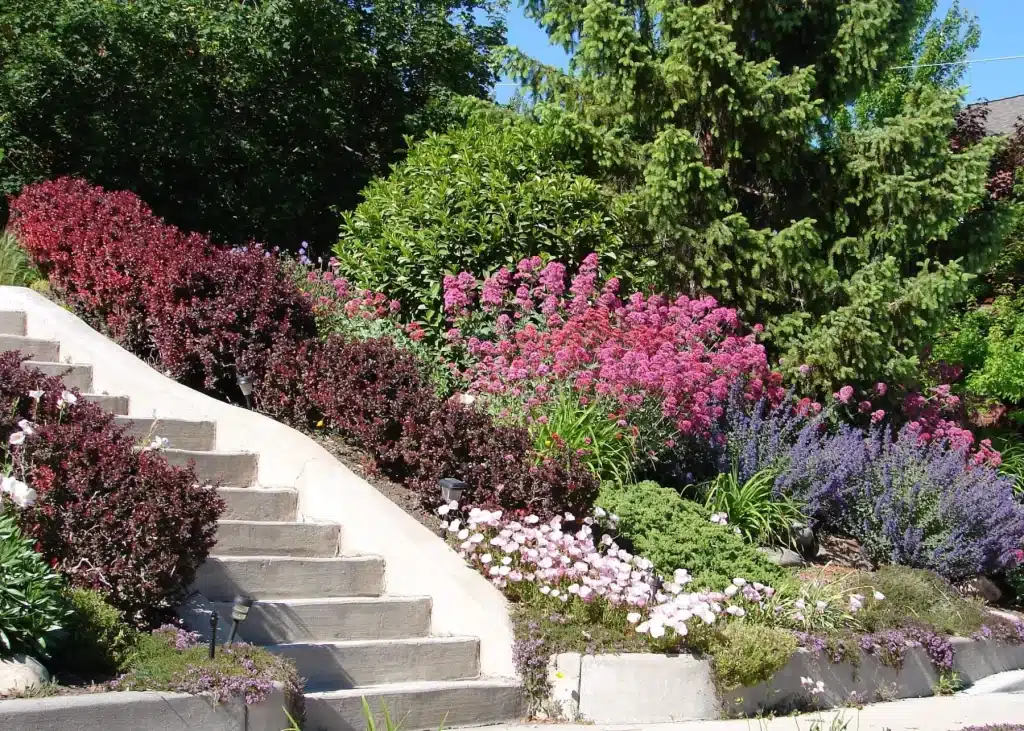
How Do Slopes Change Firewise Design?
Fire moves faster uphill, and many Grants Pass and Medford homes sit on or above slopes. On sloped lots, firewise design usually means wider spacing between plants on the downhill side, terraces or retaining walls that create flat, noncombustible breaks, and erosion control that doesn’t depend on bark mulch.
Our post on fixing a sloped backyard in Southern Oregon explains how terracing and drainage work together.
What Does It Cost to Make a Yard Firewise?
It depends on how much changes. Swapping bark mulch for rock near the house and pruning trees is a modest project. Rebuilding a whole yard with new hardscape, plantings and irrigation is a larger one. The most cost-effective time to plan for fire is during design, before anything is built. Our guide to landscape design costs in Southern Oregon explains how to budget for a plan, and phasing lets you start with the zone closest to the house.
Frequently Asked Questions
Is defensible space required in Southern Oregon?
Oregon’s defensible space model code, finalized by the State Fire Marshal in 2026, is a voluntary baseline that local governments and fire agencies may adopt. Whether it applies to your property depends on your city, county or fire district. Even where it isn’t required, defensible space is one of the most practical steps a Rogue Valley homeowner can take before fire season.
Can I use bark mulch in a firewise yard?
Yes, but not next to the house. State and OSU guidance both recommend noncombustible material such as river rock, gravel or pavers within the first 5 feet of the home and under decks. Farther out, bark mulch can still be used in well-maintained beds, ideally broken up by paths, stone and irrigated plantings.
What are fire-resistant plants?
Fire-resistant plants are less likely to ignite and produce fewer embers. They usually have moist, supple leaves, open branching, little dead material and watery sap. They are not fireproof: any plant will burn if it is dry or neglected. Healthy, watered, well-spaced plants placed away from the house give the best results.
Is xeriscaping the same as firewise landscaping?
Not exactly. Xeriscaping reduces water use; firewise landscaping reduces fire risk. They overlap well, since gravel, stone and efficient irrigation serve both goals, but some drought-tolerant plants are resinous or hold dry material, which is a fire concern. The best Southern Oregon designs plan for water and fire together from the start.
Can I make my yard firewise in phases?
Yes. Start with the first 5 feet around the house and the area under decks, then work outward through tree pruning, plant spacing and hardscape. A complete landscape plan keeps each phase consistent, so later work doesn’t undo earlier improvements.
Plan a Firewise Landscape With Hawthorne Landscaping NW
Hawthorne Landscaping NW designs and builds landscapes for homeowners in Grants Pass, Medford and surrounding Southern Oregon communities, with defensible space, water-wise planting and hardscape planned together. Fall and winter are a good time to design so your yard is ready before next fire season.
Request a landscape design consultation to get started, or learn more about our landscape design services.